Astronomers have detected a radio signal that took 8 billion years to reach Earth

Astronomers have been left stunned after discovering a radio signal that took eight billion years to reach Earth.
The recent discovery is hugely significant as it's one of the most distant and energetic radio burst ever observed by experts.
Advert
The wave is known as fast radio bursts, or FRBs for short. They are millisecond-long bursts of radio waves with unknown origins, causing much confusion among experts.
This particularly burst, which has since been dubbed as FRB 20220610A, lasted less than a millisecond.
However, in that extremely short space of time, it released the equivalent of the sun’s energetic emissions over the span of 30 years.
All of this and much more was detailed in a study published in the journal Science on Thursday (19 October).
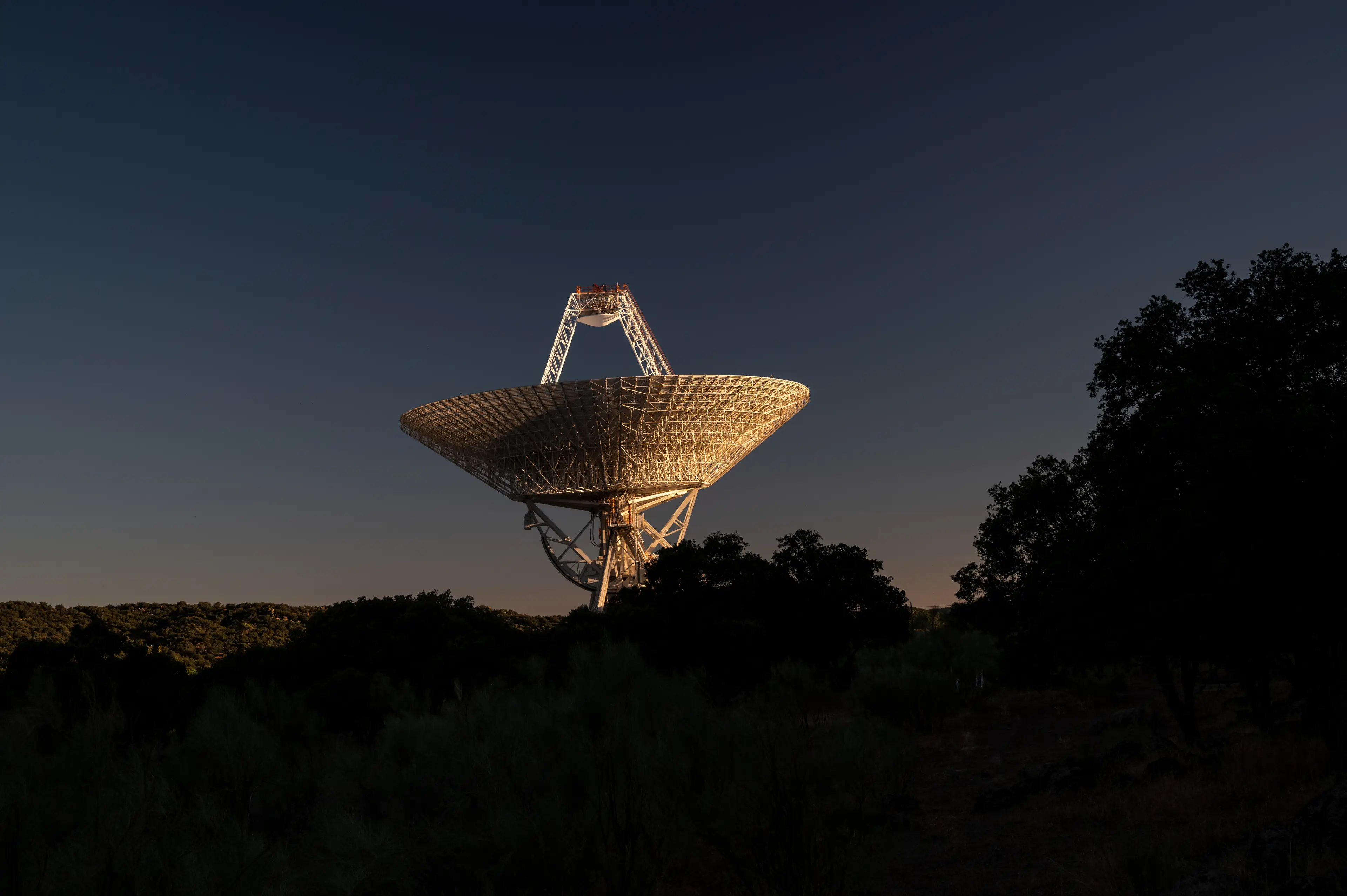
Dr. Stuart Ryder, astronomer at Macquarie University in Australia and study co-author, said: "Using ASKAP’s array of [radio] dishes, we were able to determine precisely where the burst came from.
"Then we used [the European Southern Observatory’s Very Large Telescope] in Chile to search for the source galaxy, finding it to be older and [farther] away than any other FRB source found to date and likely within a small group of merging galaxies."
The research team working on the study found what appeared to be a group of two or three galaxies that are in the process of merging.
This subsequently aligns with current theories that suggest fast radio bursts such as the one discovered as part of the study may come from magnetars, a type of neutron star with a magnetic field a trillion times strong than the Sun's.
Fellow study co-author and a professor at Swinburne University of Technology in Australia, Ryan Shannon, added: "If we count up the amount of normal matter in the Universe — the atoms that we are all made of — we find that more than half of what should be there today is missing.
"We think that the missing matter is hiding in the space between galaxies, but it may just be so hot and diffuse that it’s impossible to see using normal techniques."
He added: "Fast radio bursts sense this ionised material. Even in space that is nearly perfectly empty they can ‘see’ all the electrons, and that allows us to measure how much stuff is between the galaxies.
"While we still don’t know what causes these massive bursts of energy, the paper confirms that fast radio bursts are common events in the cosmos and that we will be able to use them to detect matter between galaxies, and better understand the structure of the Universe."
 Callum Jones