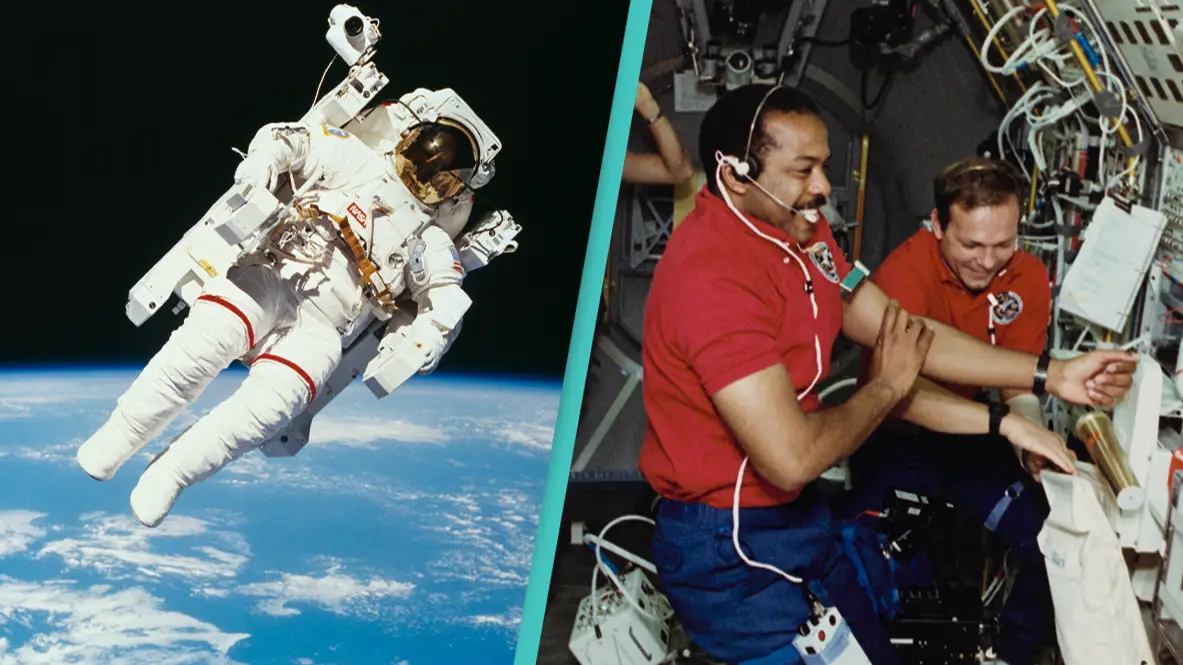
Incredible reason why astronauts age slower while they’re in space

Scientists have unpacked the head-scratching idea that time passes more slowly for astronauts than it does for the rest of us down on Earth.
Forget biohacking, jetting off into space is actually a more sure-fire way of slowing down the clock on ageing.
It sounds like something out of the film Interstellar, but the truth is the theory is very much backed up by science.
In our everyday experience on Earth, time always ticks at the same rate as we move into the future, but time is actually relative - and is experienced differently at different points in the universe, and specifically by what speed you're travelling.
Advert
The closer to the speed of light you travel relative to someone else who is travelling at a slower pace, the slower time will pass for you.
Astronauts aboard the International Space Station (ISS), for example, orbit around the Earth at 27,500 kilometres per hour.
Because they are moving faster and are closer to the speed of light than the rest of us down on Earth, time is passing more slowly for them.
As a result, astronauts age more slowly.
The BBC's Sky at Night magazine explained it like this: imagine you have a budget split between the speed you're travelling through space and time.
The faster you travel through space, the less of your budget there is to use on moving through time.
So if you're travelling faster, you experience time more slowly.
Now, when we say astronauts age more slowly than Earth dwellers, we're not talking about the kind of difference where Matthew McConaughey comes back to visit his daughter who's now decades older than him at the end of Interstellar - at least not for astronauts working on the ISS.
For instance, twins Mark and Scott Kelly both happened to be NASA astronauts, but Scott spent about ten times longer in space.
He was sent off to the ISS for a year to see what impact it would have on his body in comparison to his twin.
Before they both jetted off to space, Mark was six minutes older than Scott.
After his time on the ISS, Scott was six minutes and five milliseconds older.
So it's really not that much.
The more important finding of the study was that the long period in space had no significant long-term effects on Scott's body, which is a positive sign if we're looking to send humans to Mars anytime soon.
 Callum Jones