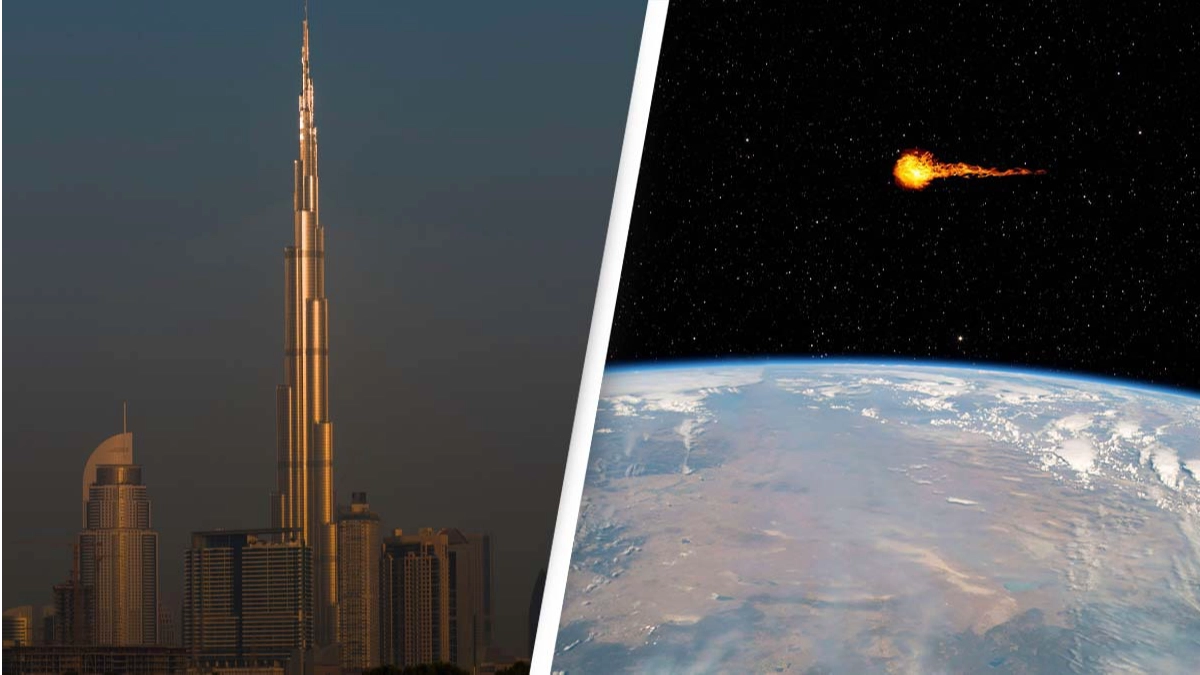
Asteroid Twice The Size Of World’s Tallest Building Will Soar Past Earth This Week

Scientists have discovered a ‘potentially hazardous’ asteroid, 1.1 miles in diameter, that will pass by the Earth this Friday, 27 May.
The world’s tallest building has been the Burj Khalifa, located in Dubai, since it was built in 2004. It towers over the landscape an at enormous 2,722ft, but will be only half the size of the asteroid set to pass our planet this week.
The asteroid, named 7335 (1989 JA), has been classified by NASA as ‘potentially hazardous’, though it is unlikely to become a threat to the planet in any way.
It is set to be the largest rock to pass Earth this year, and while the chances of the asteroid hitting us are significantly low, the chances of a collision in the future have not been discounted by NASA.
The famous space administration agency has a catalogue of ‘near Earth objects’ (NEOs), and is said to discover 30 new ones each week. NASA has warned that the catalogue of rocks is not complete, meaning that an unprecedented impact could realistically occur at ‘any time’.
Advert
The asteroid will be closest to Earth at 14:26 UTC on Friday, 27 May, at which point it will be 0.026 astronomical units (2.5million miles) from Earth. The rock will travel at 29,348 miles/hour, which is nearly 15 times faster than the speed of a bullet being shot.
NASA has said that 'impacts of larger objects are expected to be far less frequent (on the scale of centuries to millennia)'.
NASA added: "Experts estimate that an impact of an object the size of the one that exploded over Chelyabinsk, Russia, in 2013 – approximately 55 feet (17 meters) in size – takes place once or twice a century.
"Impacts of larger objects are expected to be far less frequent (on the scale of centuries to millennia).
"However, given the current incompleteness of the NEO catalogue, an unpredicted impact – such as the Chelyabinsk event – could occur at any time."
The Chelyabinsk event was an object 55 feet in size that exploded over Russia in 2013. In preparation for incidents like these, NASA announced its first ‘planetary defence’ spacecraft in November 2021, which can deflect an asteroid 6.8million miles from Earth, and will likely inform missions in the future that could save Earth from a cataclysmic event.
If you have a story you want to tell, send it to UNILAD via [email protected]
 The UNILAD Team