unilad homepage
unilad homepage
    • News
      • UK News
      • US News
      • World News
      • Crime
      • Health
      • Money
      • Sport
      • Travel
    • Music
    • Technology
    • Film and TV
      • News
      • DC Comics
      • Disney
      • Marvel
      • Netflix
    • Celebrity
    • Politics
    • Advertise
    • Terms
    • Privacy & Cookies
    • LADbible Group
    • LADbible
    • SPORTbible
    • GAMINGbible
    • Tyla
    • UNILAD Tech
    • FOODbible
    • License Our Content
    • About Us & Contact
    • Jobs
    • Latest
    • Archive
    • Topics A-Z
    • Authors
    Facebook
    Instagram
    X
    Threads
    TikTok
    YouTube
    Submit Your Content
    NASA says an asteroid the size of an Olympic swimming pool could hit Earth in 23 years

    Home> News

    Published 16:01 9 Mar 2023 GMT

    NASA says an asteroid the size of an Olympic swimming pool could hit Earth in 23 years

    There's a chance that the asteroid could hit Earth, but what are the odds of it actually happening?

    Joe Harker

    Joe Harker

    google discoverFollow us on Google Discover
    Featured Image Credit: NASA/Shutterstock

    Topics: NASA, Space, Science, World News, News

    Joe Harker
    Joe Harker

    Joe graduated from the University of Salford with a degree in Journalism and worked for Reach before joining the LADbible Group. When not writing he enjoys the nerdier things in life like painting wargaming miniatures and chatting with other nerds on the internet. He's also spent a few years coaching fencing. Contact him via [email protected]

    X

    @MrJoeHarker

    Advert

    Advert

    Advert

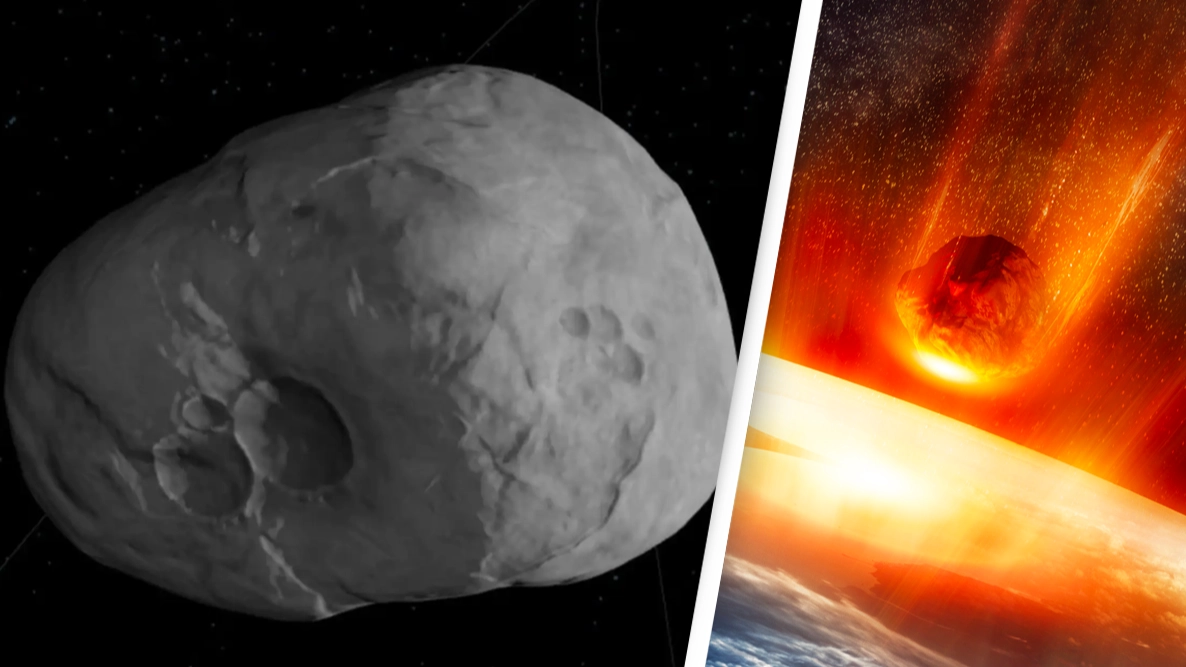
    An asteroid the size of an Olympic swimming pool with a chance of striking planet Earth in about 23 years time has been detected.

    Humanity's ability to peer into the far-off reaches of space is getting rather amazing considering the wonderful things we've been able to see.

    We've spotted galaxies which technically shouldn't exist but somehow do thanks to the James Webb telescope, and we've witnessed a supermassive black hole devouring a star by twisting it into a donut shape.

    Advert

    Even mysterious signals from nine billion light years away are no match for our ability to detect and identify them, so barring some manner of sudden alien invasion I think it's safe to say we're getting quite good at this space thing.

    However, one constant concern is that of all the things hurtling around out there in space one of them could be headed right for us, ready to cause catastrophic damage to our planet and our way of life.
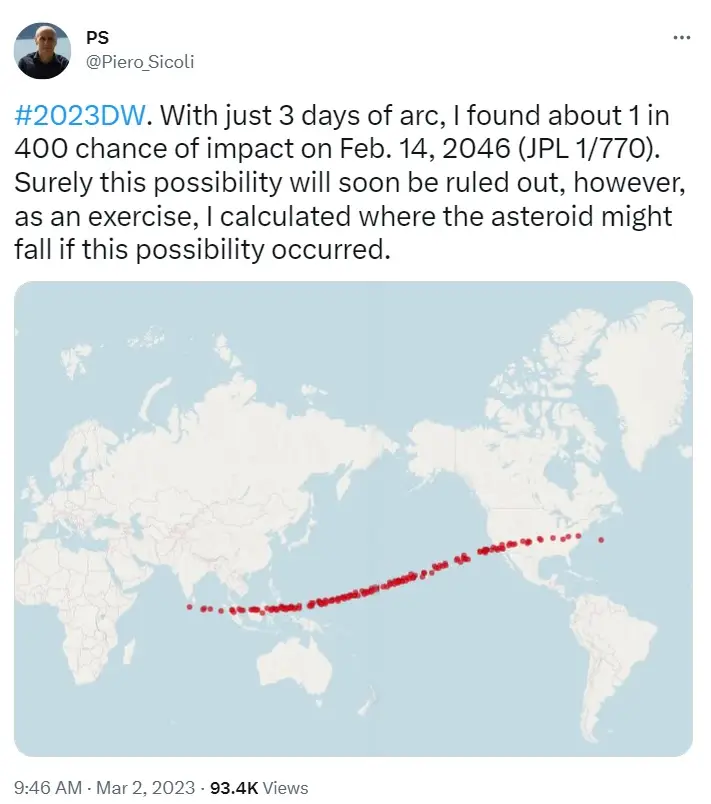
    This thing has almost zero chance of actually hitting us, but if it does you don't want to be living anywhere along this red line.
    Twitter/@Piero_Sicoli

    On that note, an asteroid is actually headed our way and according to NASA it could hit our planet in 2046, otherwise known as about 23 years from now.

    Fortunately this asteroid heading in our general direction is not quite the nine-mile wide monstrosity that wiped out the dinosaurs, as it's apparently closer to the size of a swimming pool.

    While you wouldn't want to be where it hits it wouldn't be game over for the human race, and even more fortunately the European Space Agency measures the chances of it actually hitting us at only about one in 625, while other expert assessments give it similarly unlikely odds of striking us.

    If it did strike us then the likely date of impact would be 14 February, Valentine's Day, but it's incredibly unlikely that such a thing would happen.

    Of all the objects in space we're monitoring all but one of them have a Torino scale (used to rate the risk of something hitting Earth) rating of zero, while this asteroid has a rating of one.

    For context, that means it's 'extremely unlikely with no cause for public attention or public concern' so there's really nothing to worry about.
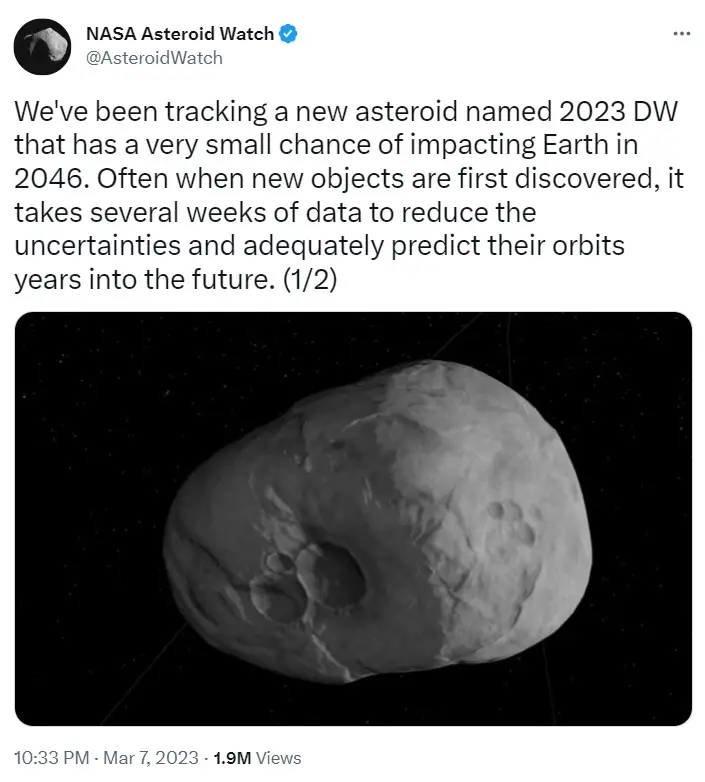
    NASA are aware of the asteroid, which is called 2023DW.
    Twitter/@AsteroidWatch

    Even on the off chance that this swimming pool sized asteroid is headed right for us and is going to slam into planet Earth there's still very little reason to fret.

    NASA have plans in place in case an asteroid is on collision course with our planet and they believe they have the know-how to knock something headed our way in another direction.

    Last September NASA launched the Double Asteroid Redirection Test (DART), which involved ramming a spaceship into a chunk of rock in space and successfully knocking it off course.

    The space agency have declared that they are now confident in their ability to stop a potentially deadly asteroid from hitting us and sending us the way of the dinosaurs.

    There you go, nothing to worry about.

    Choose your content:

    11 mins ago
    17 mins ago
    an hour ago
    12 hours ago
    • Anna Moneymaker/Getty Images
      11 mins ago

      Trump accused of going 'too far' after making comments on Iran war in front of school kids in Oval Office

      The president didn't hold back when giving an honest review of the war in Iran

      News
    • Getty stock image
      17 mins ago

      Doctor issues warning to people who sleep on their front as it could lead to painful condition

      Sleeping on your front is not just bad for your health, it can also give you wrinkles

      News
    • AFP via Getty Images
      an hour ago

      Two terrifying possible causes of hantavirus as three dead following cruise ship outbreak

      There's been an outbreak on the Dutch-flagged cruise ship MV Hondius

      News
    • Getty Stock Image
      12 hours ago

      Pilot explains why there are tiny holes in every plane window

      Despite the small size, they actually serve a pretty important purpose...

      News
    • NASA reveals truth behind asteroid hurtling past Earth at 46,908 mph next week
    • NASA just made astonishing find on asteroid and it could bring us closer to answering age-old question
    • NASA discovers potentially habitable planet 'remarkably similar to Earth'
    • NASA finds unknown object in deep space that's sending mysterious signals to Earth every 44 minutes