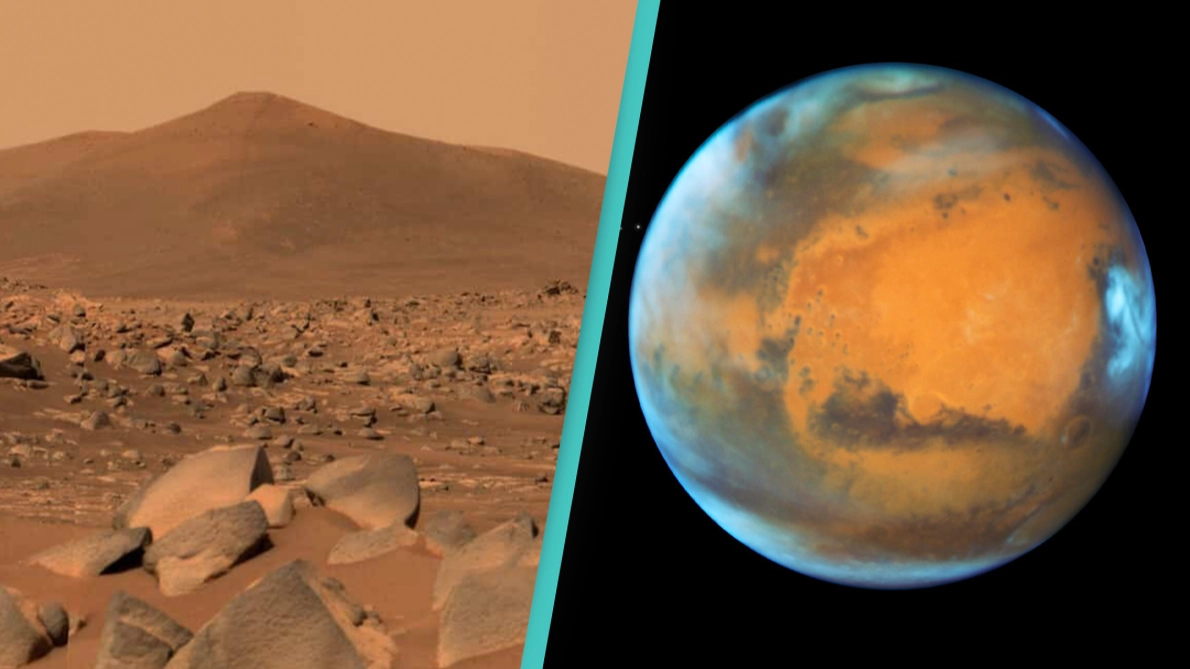
Mars declared unsafe for humans to live as scientists explain why it'd never work

The idea of living on Mars has peaked the interest of astronomers for many a year, but it may not be as feasible as we all think.
After landing robots on the red planet with any hiccups, the next step for NASA is to get actual people on Mars.
The space agency has said in the past that Mars is 'one of the only other places we know where life may have existed in the solar system'.
As a result, further exploration on the planet could help offer insights to the past and future of planet Earth.
Advert
So when are NASA hoping to get folks on Mars? Well, the space agency has suggested the tech could propel humans to the planet as early as the 2030s.
But that doesn't mean a long-term life on Mars is plausible or even possible.
Last year, researchers combined studies from the likes of UCLA, MIT, Moscow’s Skolkovo Institute of Science and Technology, and GFZ Potsdam to look into the potential impacts of life on the red planet.
Researchers sought to answer two questions: one focused on the impact of particle radiation and whether it would pose too grave a threat to human life, and the second about whether the timing of a mission to Mars could protect astronauts and the spacecraft from radiation.
On the hunt for answers, scientists used geophysical models of particle radiation for a solar cycle and models of how radiation could affect both human passengers and a spacecraft.
Following the study, which was published in the Advancing Earth and Science Journal, the researchers found that it would not possible for humans to stay on Mars long-term.
They found that human exposure to radiation threats, including particle radiation from the Sun, distant stars, and galaxies, would exceed safe levels after four years on the planet.
The scientists did determine that the spacecraft used to travel to Mars should provide enough protection for the trip to and from the planet - but if the material used to build the spacecraft is too thick, then it could actually increase the amount of secondary radiation.
Researchers also claimed the best time to leave Earth would be when the solar activity is at its peak and the most dangerous particles are deflected, thus shielding the astronauts from the worst of it.
"We estimate that a potential mission to Mars should not exceed approximately four years," the researchers explained.
"This study shows that space radiation imposes strict limitations and presents technological difficulties for the human mission to Mars, such a mission is still viable."
In summary, there's every possibility we may see humans on Mars in the coming years, but living there? Well, that's a different story.
 Callum Jones